Why Domestic Hot Water Lines Fail First in Goodyear Homes
In master-planned communities across Goodyear—from the established subdivisions of Palm Valley and PebbleCreek to newer phases throughout Canyon Trails and Estrella—homes rely on domestic hot water loops buried directly in the soil before concrete was poured. While cold water lines maintain relatively stable temperatures, hot water lines fluctuate between ambient room temperature and 125 degrees Fahrenheit multiple times each day.
This temperature variance forces copper metal to expand longitudinally whenever a shower, dishwasher, or sink is turned on, and contract when turned off. In Goodyear, un-sleeved copper lines rub repeatedly against hard, jagged caliche rocks present in desert subsoil. Over years of thermal cycling, this mechanical friction grinds away the copper wall from the outside while mineral-heavy hard water corrodes it from the inside, triggering a severe hot water line leak under slab Goodyear homes cannot afford to ignore.
Recognizing Symptoms of a Hot-Side Slab Leak
Warm Spot on Floor Goodyear
Walking barefoot across hallway tile, laundry room vinyl, or bedroom carpeting and detecting an isolated hot or unusually warm floor section is the primary symptom of hot water pooling under concrete.
Water Heater Running Constantly Goodyear
Hearing your tank water heater in the garage firing or humming non-stop without any indoor faucets running indicates that hot water is continuously escaping into the sub-slab soil.
Surging Utility Energy Bills
Because your water heater burns fuel nonstop to heat water that leaks directly under the foundation, monthly Southwest Gas or APS energy bills can spike by hundreds of dollars.
Locating Hot Water Leaks with High-Resolution Thermal Imaging
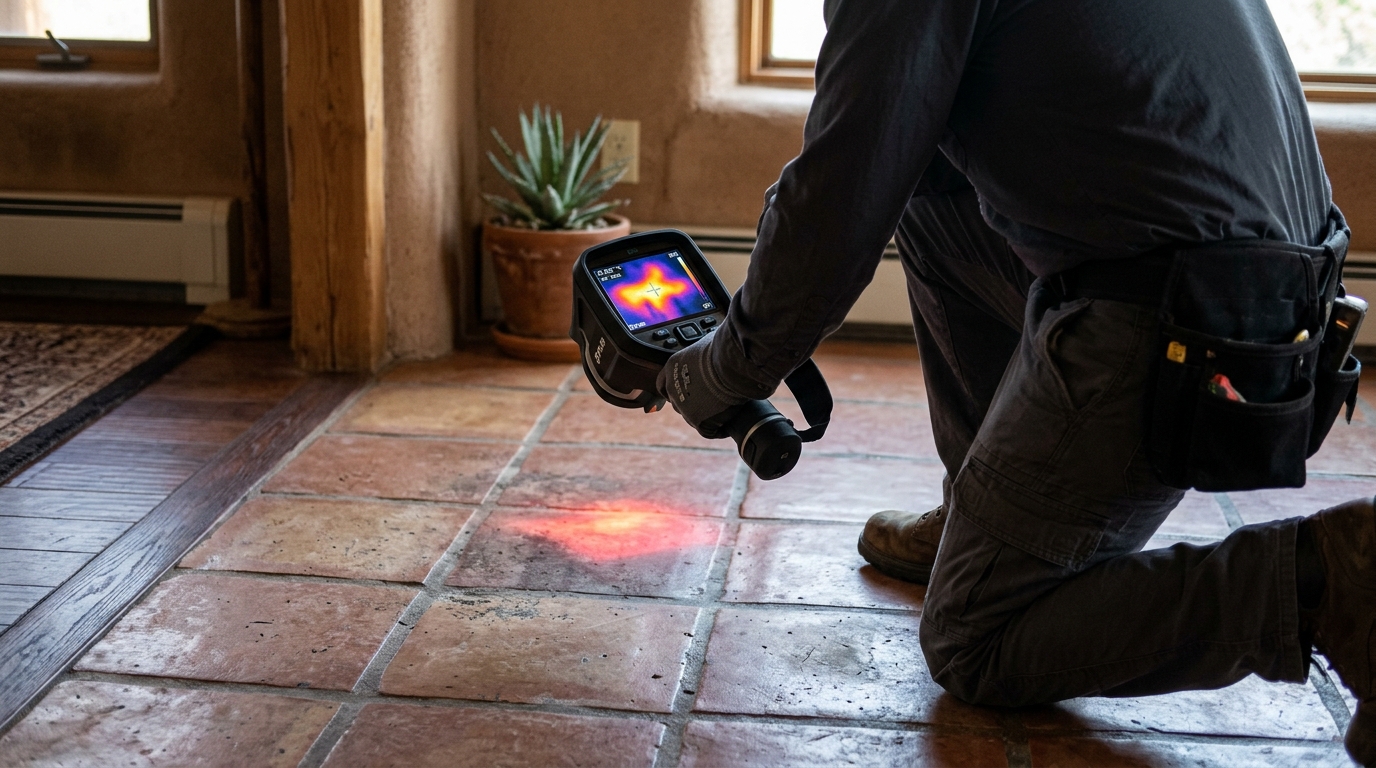
Locating hot-side ruptures is expedited through thermodynamic scanning. Because heated water warms the surrounding concrete, high-resolution FLIR infrared thermal cameras scan the flooring from above. The escaping water produces an identifiable thermal bloom, highlighting the exact area of subterranean saturation.
Once mapped visually, technicians apply acoustic ground sensors to listen for the high-frequency hiss of escaping pressurized water, confirming the exact coordinate before presenting repair choices. Learn more about acoustic tools on our slab leak detection page.
Repair vs. Overhead Reroute of the Leaking Hot Line
Homeowners in Goodyear generally face two repair paths when addressing a hot water failure:
- Direct Concrete Spot Repair: Requires cutting through tile and concrete to solder a new copper section. However, because the remainder of that buried copper line has endured the same thermal stress, a spot repair may simply shift hydraulic pressure to another weakened point.
- Overhead PEX Reroute (Recommended): The leaking line is permanently disconnected and capped at both manifold ends. A new, flexible PEX line is installed overhead through interior walls and attic spaces, leaving your flooring completely intact. Learn more on our under-slab pipe repair page.
Protecting Attic Overhead Lines from Goodyear Summer Heat
When executing an overhead reroute in Goodyear, where attic temperatures frequently surpass 140 degrees in summer, proper installation is critical. All overhead PEX lines must be routed beneath primary blown-in fiberglass insulation blankets and encased within thick closed-cell foam sleeves to ensure thermal efficiency.
For comprehensive foundation leak information, return to our slab leak repair Goodyear AZ homepage.